

Well a set of orders came to Saint Pete
for someone to go to C130 school in Tennessee and I will give you
three guesses who voluntered to go?.First two don't count.
The Airforce instructors were great.Who ever heard about cabin pressurization,turbine engines and all that new fangled stuff?Not I!!They were over and above in helping me in learning about all the new things I had to learn.
Here I go back to Elizabeth City again,but on the other side of the fence.CGAS Elizabeth City NC.
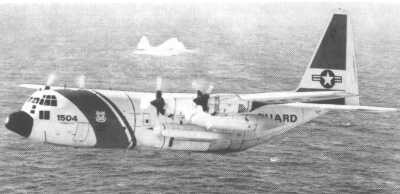
The 1339 our new gem was picked up and we immediately commenced using her to good advantage.A long distance aircraft specially outfitted with plexiglass hatches for searching and a proven low maintenance plane.Very dependable.
A real good observation spot was devised by someone and I used to grab it when I could.You walk up the aft cargo ramp and there is a seat there.You strap yourself in and they open the ramp.What a platform.Its like watching the sea and the sky in IMAX.(beautiful)
It was great flying in the Herk but I kept gravitating to the helos.When I wasn't scheduled to fly in the big one I would weedle helo flights to get my foot in the door with the HO4S crew.
As luck would have it Our Shop Chief
retired and wasn't replaced so I ended up in charge of the shop.(GoodGrief)Flight
time is going to diminish and I will be miserable.Well it didn't
turn out too bad, because I couldn't tool around in the Herk, I
was able to get to be on the ready helo on duty days and so I
guess it all equaled out.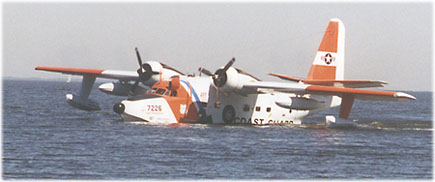
Even got to be a HU16 aircrewman.More fun with water landings and all but most of the time(these planes had wheels)we used the runway.
Grumman HU-16 Albatross (1955-1977) Originally designated as the UF-1, the designation was changed in the early '60's to the HU-16E. All Coast Guard UF-1 series aircraft were converted with a stretched wing configuration to improve performance. The "Stretched Wing" version of the Albatross was the workhorse for U.S. Coast Guard Search and Rescue (SAR) during the 60's and 70's. The Coast Guard operated 77 of these aircraft for many years. Most were retired upon reaching a service life of 11,000 hours. In 1962, three world records were won by U.S. Coast Guard pilots with this aircraft. CDR W. C. Dahlgren was credited with the speed record of 200 knots on a 1000 KM closed course carrying 1000 and 2000 KG weights. CDR W. G. Fenlon was awarded a world record for distance flown completing a 3107 mile flight from Kodiak, Alaska, to Pensacola, Florida, in 18 hours and 23 minutes. Finally, an HU-16 stationed at Air Station Brooklyn, New York, was flown by Coast Guard pilots to a new world altitude record for this category aircraft.
By having to not do a lot of flying in
the C130 the only really big thing I missed out on, was breaking
the distance record for that type of aircraft.Early on I told you
circumstances dictate your claim to fame.It was our airplane and
our guys thats all
that matters.
all
that matters.

Elizabeth City Was a busy station also but we had more men and flights were devided up all the way around.Our main job was aircraft maintenance.Flying as crew was a secondary job.Airplanes are a continuing job.Preflight,post flight,fueling,10 hour inspections,so many hours or days inspection.Components change on routine basis so many hours or month inspections.Not to mention repairs to things that are found wrong during routine flights.It wasn,t uncommon to have men working 14 hours a day on our aircraft, with two or three in check at one time plus unscheduled maintenance.
Under extreme conditions, there were
times round the clock work was beeing done.It wasn't just at E
City but it happened at times everywhere I am sure.It was
imperative to have as many airplanes available as possible at all
times if needed.When we went below our limit, it meant work till
we are up.



So grab the maintenance manuals and your tool boxes and get
those planes up and ready.
I never realized how much work could be done by men who are dedicated, without a lot of whining,belly acheing and crying.
After years in civilian life I know that these were men on a mission and with a purpose.Things like this is what I guess makes me so proud to have served with the groups of people that I did.Cooperation,team players,unselfish and devoted to their profession.
This is as good a place as any to explain that as I said before,we were trained in all aspects of our jobs.We worked on,flew in,washed,waxed,gassed,oild,inflated the tires ad infinitum.Our function was AtoZ.
Maintaining and flying in your own aircraft is a great concept.Good availiability and limited down time is a credit to everyone involved.Also you, your friends and shipmates fly what you fix ,so extreme care is given to every part of the maintenance you perform.
I would never have hesitated to go from one unit to another, jump into one of their aircraft and head out.No questions asked.
There is no significance to this except its downright purrty.I had thought about using this for something else but making it bigger distorts it.This is a good a place for it as any.
As you can tell this is a work in progress and I just recieved email from a couple of my old shipmates who say I am making myself sound like someone with his head in the clouds and need to let folks know more about my reasons for being in CG rescue.
Okay when I was young I wanted to be a priest or doctor.Well when your father works in a shoe factory in Maine in those days collage was out.
Priesthood went out the window when I went to a coed school in my junior year of high school(No snickers please)
When I was home once My uncle John who was a CG Warrent Officer was on leave from recruting in Wilkesbarre PN.and filled me in on the Guard and the likelyhood of being able to fly and be a rescueman and it sounded good.(I really am a people person)
 When I retired from the CG, I went to nursing
school and had another 22 year career caring for severely
handicapped and terminally ill young people and some adults.
When I retired from the CG, I went to nursing
school and had another 22 year career caring for severely
handicapped and terminally ill young people and some adults.
Enough of this.This is a CG Air site.Maybe I will do one on nursing..